
SAP Commerce Cloud Architecture
Everything you need to understand about SAP Commerce Architecture, the layered, cloud-native design that powers enterprise e-commerce at scale.
What is SAP Commerce Cloud?
SAP Commerce Cloud (formerly known as SAP Hybris) is one of the world’s most powerful enterprise commerce platforms. Specifically, it is built for scale, flexibility, and deep enterprise integration, while following a layered, cloud-native architecture. Indeed, what sets it apart from simpler e-commerce tools is its ability to handle the complexity that large businesses demand. For example, it manages multiple storefronts, languages, and currencies alongside millions of products. Furthermore, it provides seamless connections to other enterprise systems like ERP and CRM.
Table of Content
SAP Commerce Architecture Overview
At the heart of SAP Commerce Cloud is a modular, layered architecture. In fact, once you understand that structure, everything else about the platform starts to click. The layers run from the cloud infrastructure right up to the storefront, with the type system, business services, and API layer sitting in between. Moreover, what makes this practical rather than just a nice diagram is that each layer has a clearly defined responsibility. As a result, it maintains clean boundaries with the layers around it.
For instance, when you need to scale API nodes under heavy traffic, you do that without touching the storefront. Similarly, when you extend the platform with a custom extension, you’re plugging into the architecture rather than hacking around it. Ultimately, that separation of concerns is what allows SAP Commerce Cloud to handle the kind of complexity – multi-site setups, high transaction volumes, and deep ERP integrations – that would bring a less structured system to its knees.
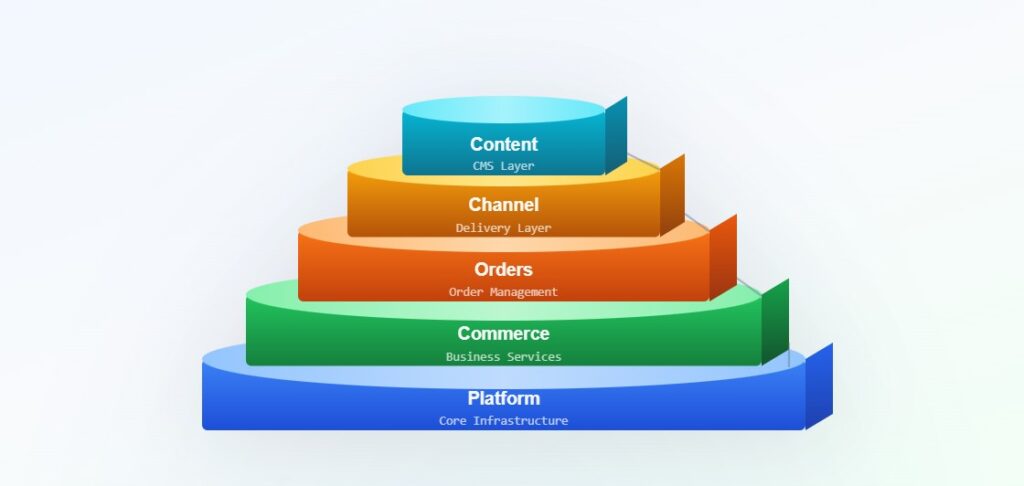
Layer-by-Layer Breakdown
Let’s explore each architectural layer in detail to understand what it does, why it exists, and see real-world examples of how developers work within it.
Content:
To begin with, the Content layer manages all the information displayed on the website related to products and website pages. Furthermore, content layer can integrate with external systems such as ERP, CRM, billing, and logistics platforms. By doing so, it provides the structures and services needed to organize and present products to customers. Specifically, this includes product catalogs, categories, classification attributes, and media.
Channel:
Following the content, the Channel layer defines the various touchpoints through which customers interact with businesses. In today’s omnichannel world, customers expect a seamless experience whether they are on a smartphone, a laptop, a kiosk, or even chatting with a support bot. To meet these expectations, SAP Hybris supports multiple channels.
Specifically, SAP Hybris supports channels including:
- Web – desktop and laptop browsers
- Mobile Apps – native iOS and Android applications
- In-Store – point-of-sale and kiosk integrations
- Chat and Community – live chat tools and community platforms
- Social Feeds – commerce touchpoints on social media
Furthermore, the Channel layer ensures that all of these entry points connect to the same underlying commerce logic and data. Consequently, a customer who adds items to their cart on mobile can complete the purchase on desktop without losing their session.
Order:
The Order layer is responsible for the end-to-end lifecycle of a transaction, from order capture to final delivery and potential returns. Specifically, the order management process includes order creation, payment processing, inventory management, and fulfillment. Additionally, this layer manages order history and customer service support. Beyond the initial purchase, it also handles after-sales processes such as order cancellations, returns management, and refund processing.
Commerce:
In contrast to the operational layers, the Commerce layer serves as the brain of the SAP Commerce application. Indeed, it contains the core business functionality required for running a robust eCommerce platform. For instance, the Commerce layer is responsible for business logic implementation, customer interaction management, and search functionality. Furthermore, it handles complex tasks like product bundling and promotion-coupon management. Ultimately, this layer is responsible for driving the actual commerce experience for your customers.
Platform Layer:
Basically, the platform is the lowest layer and forms the foundation of the SAP Commerce architecture. Because it provides the core infrastructure, every other layer depends on it. Specifically, the Platform is responsible for storing and retrieving data from the database while improving performance by keeping frequently accessed data in memory. In addition, it handles tracking system activity for debugging and monitoring. Moreover, it manages authentication, authorization, and data protection for security purposes. Ultimately, without the Platform layer, nothing else in SAP Hybris can function, as it is the engine room of the entire system.
A layered, modular platform — from core infrastructure up to customer-facing channels. Click any section to explore its capabilities.
- Product & Website Content
- 3rd Party Systems — ERP, CRM, Billing
- Logistics
- Business Logic & Processes
- Site Interactions with Customers
- Search Functionality
- Bundling
- Promotions & Coupons
- Fulfillment, Inventory
- Sourcing, Shipping
- After Sales Cancelation
- Returns & Refund
Interactive diagram — click any component to explore its role and capabilities.
Spartacus SPA
WebSvc
Platform
Now that you have a solid understanding of the five core building blocks, it is time to look inside the engine room. While the basic architecture tells you what SAP Commerce does, the detailed architecture shows you how the platform actually organizes itself internally. This is significant because this is where you will spend most of your time as a developer.
You can think of the detailed architecture as opening the hood of a car. Indeed, everything you saw in the basic diagram is still there; however, now you can see the engine in full detail.
Client Layer (Presentation Layer):
At the outermost level are the client applications, which include web storefronts, mobile apps, and other digital channels. For instance, modern implementations often use JavaScript-based Single Page Applications (SPA) such as Spartacus. In addition to this, these frontends focus on the user experience and communicate with the backend through OCC (Omni Commerce Connect) APIs; consequently, this enables a headless commerce approach.
Meanwhile, on the back office side, the Backoffice Framework handles everything internal -administration, customer support, order fulfillment, and adaptive search. Furthermore, SmartEdit lives here too, giving marketing teams a visual content editor without ever touching code.
API Layer (OCC Layer):
The API layer exposes commerce functionality through REST services. Specifically, these APIs allow frontend applications to access features such as product search, cart management, checkout, and customer account services. Beyond these features, this layer also supports integration with enterprise systems like ERP, CRM, payment providers, and logistics services, often through the SAP Business Technology Platform (BTP).
Core Commerce Layer:
At the core lies the SAP Commerce application layer, which contains the main business capabilities of the platform. In particular, this includes modules responsible for pricing, promotions, cart operations, catalog management, and order processing. Additionally, administrative tools like Backoffice allow business users to manage products, catalogs, and orders. Furthermore, the platform’s extension-based architecture enables developers to add custom functionality without modifying the core system. Consequently, this provides a highly flexible environment for bespoke business requirements.
Platform Service Layer:
To support these core modules, the platform provides shared capabilities such as user management, authentication, and catalog services. Additionally, the platform runs on an Apache Tomcat application server. In this capacity, it handles crucial request processing and application execution smoothly.
Persistence Layer:
Finally, the persistence layer manages data storage and retrieval using the SAP Commerce type system and Flexible Search queries. As a result, the platform supports multiple databases such as SAP HANA, Oracle, MySQL, and SQL Server. Consequently, it is typically deployed on cloud infrastructure like Azure and Kubernetes to ensure scalability and reliability.
Ultimately, that layered separation is not just architecture for architecture’s sake. Instead, it serves as the foundation that makes SAP Commerce genuinely extensible without causing system-wide chaos
Why This Architecture Matters
The layered design of SAP Commerce Cloud is not just a technical choice; rather, it directly solves real enterprise business problems through its structured approach:
- Headless flexibility: Any frontend connects via OCC APIs. Consequently, you can switch from Angular to React without ever modifying the backend, which makes the system highly adaptable.
- Safe customization: Moreover, custom code is maintained strictly within extensions and never within the SAP core. As a result, platform upgrades remain smooth and non-disruptive.
- Enterprise scale: Kubernetes autoscaling handles 10x traffic spikes automatically during flash sales
- Deep SAP integration: Furthermore, native connectivity to S/4HANA, CPI, and the broader SAP ecosystem is built-in. Therefore, a unified and seamless data flow across the business is achieved.
- Operational simplicity: Finally, the Cloud Portal and managed infrastructure eliminate manual server management. Ultimately, this allows teams to focus more on development rather than maintenance.
Really usefull alll the blogs, Aprreciate your time and efforts put into this.
I am Hybris developer with 4+ years of experience. Found this blogs really usefull at work and preparing for interviews.